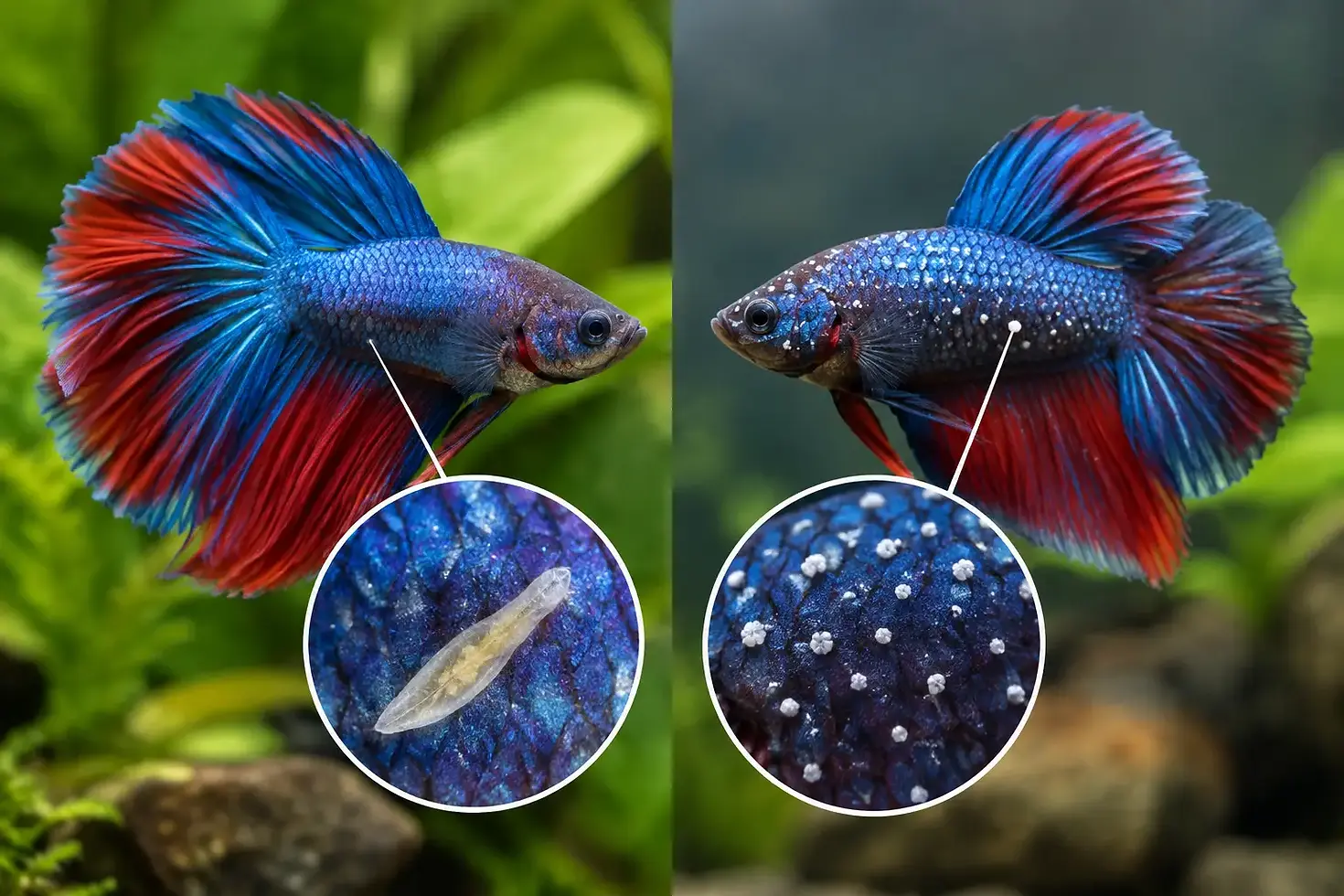
Fish Flukes Versus Ich: How to Tell Them Apart
A fish that flashes against the heater, clamps its fins, and breathes harder than usual may have either of two common parasite problems. Fish flukes versus ich is one of the most consequential distinctions an aquarist can make, because the diseases can look similar at first but do not respond to the same treatment plan. Treating visible irritation as ich without confirming the cause can cost valuable time and place additional stress on already compromised fish.
Fish Flukes Versus Ich: The Core Difference
Ich is caused by a single-celled ciliate parasite. In freshwater fish, the disease is commonly associated with Ichthyophthirius multifiliis. Marine fish can develop a similar-looking but distinct disease caused by Cryptocaryon irritans, often called marine ich. The classic sign is a scattering of raised white spots that resemble grains of salt on the body and fins.
Flukes are flatworms, most commonly monogenean parasites of the skin and gills. They attach to the fish with specialized hooks and feed on mucus, skin cells, and in some cases blood. A fish can carry a substantial fluke burden without showing obvious white dots. Gill flukes, in particular, may cause severe respiratory distress while remaining invisible to the naked eye.
This difference matters in practice. Ich is often recognized by its characteristic spots and predictable life cycle. Flukes require closer observation, and the most reliable confirmation is a microscopic examination of a skin mucus or gill sample by an experienced person. Visible symptoms are useful clues, but they are not a diagnosis by themselves.
What You Can See in the Aquarium
Both infections can cause flashing, excess mucus, reduced appetite, clamped fins, isolation, and rapid breathing. These shared signs are why fish flukes versus ich can become confusing in a busy aquarium or pond. Look for the pattern of symptoms, not one sign in isolation.
Signs More Consistent With Ich
Ich spots are generally small, round, and distinctly raised. They may first appear on the fins before becoming more visible across the body. The number of spots can increase quickly over several days, although spots may seem to disappear temporarily as mature parasites leave the fish to continue their life cycle elsewhere in the aquarium.
A fish with ich often rubs against decor, gravel, or equipment. As the parasite invades the gills, breathing may become rapid and fish may gather near water movement or the surface. In advanced cases, the fish becomes lethargic, darkens in color, and stops feeding.
Do not assume every white speck is ich. Air bubbles, sand particles, breeding tubercles, lymphocystis, and excess mucus can all be mistaken for white spot disease. Ich spots have a consistent salt-grain appearance and are embedded in the skin or fin tissue rather than loosely resting on the fish.
Signs More Consistent With Flukes
Flukes often produce a dull or cloudy skin appearance because the fish increases mucus production in response to attachment and irritation. You may see localized redness, small hemorrhages, frayed fins, or areas where scales stand out. These changes are variable and can be subtle.
Gill flukes are especially likely when one or more fish show persistent heavy breathing, hold one gill cover partly closed, breathe asymmetrically, or remain near a strong current. Some fish repeatedly yawn or make exaggerated gill movements. A fish may appear outwardly clean while the gills are heavily affected.
Skin flukes can sometimes be seen under magnification as tiny, moving, translucent worms, but aquarium viewing alone is not enough for a secure identification. A skin scrape examined immediately under a microscope can show the parasite, its hooks, and sometimes internal structures. This is the point at which treatment becomes targeted rather than speculative.
Why Timing Creates Confusion
Ich does not remain visible on the fish throughout its entire development. The white spots represent the feeding stage in the skin or gills. After leaving the fish, the parasite forms a reproductive cyst in the environment and later releases infective free-swimming stages. Most ich medications work against these free-swimming stages, not against parasites protected under the fish's skin or inside a cyst.
That is why a single treatment is commonly inadequate. Water temperature influences how quickly the life cycle progresses, so treatment duration must be based on the product directions, the water temperature, and the species being treated. Stopping when the spots disappear is a common cause of relapse.
Flukes have a different challenge. Some species lay eggs that are not affected by many treatments, while others give birth to live young. Egg-laying flukes may require repeated treatment after eggs hatch. This is one reason a diagnosis of simply “flukes” is less precise than it sounds. Knowing whether the parasite is primarily on the skin or gills, and whether eggs are present, improves the treatment schedule.
How to Confirm the Diagnosis Before Treatment
Start with water quality. Test ammonia, nitrite, nitrate, temperature, pH, and oxygenation. Poor water conditions can cause gill irritation and flashing without a parasite, while also making a true parasite infection more dangerous. Correct water quality problems promptly, but do not assume they explain every symptom.
Then observe several fish, not just the first sick individual. Are white spots spreading through the group? Is heavy breathing the dominant sign? Are symptoms confined to newly introduced fish, or are long-term residents also affected? Recent additions, shared equipment, live foods, and plants can all introduce parasites.
A microscope is the most valuable diagnostic tool when flukes are suspected. A gentle mucus scrape from a freshly affected fish can reveal flukes clearly at low magnification. Gill examination requires greater skill because gill tissue is delicate and handling stress can be serious. If you do not have the equipment or experience, seek help from an aquatic veterinarian, fish health professional, or a knowledgeable diagnostic service rather than repeatedly changing medications.
Clear disease photographs and videos are also useful for comparing visible signs, but they should support direct examination rather than replace it. Gerald Bassleer Books emphasizes this practical approach: match what you see to the disease pattern, then confirm where possible before selecting treatment.
Treatment Principles for Ich
Treat the entire affected aquarium or system unless fish have been isolated before exposure. Ich has an environmental stage, so treating only visibly spotted fish usually fails. Remove activated carbon or other chemical media that may absorb medication, while maintaining strong aeration and stable water quality.
Use a medication specifically labeled for the type of ich and the system involved. Freshwater ich and marine ich are not interchangeable problems, and marine invertebrates may be highly sensitive to many fish medications. In reef systems, the practical answer is often to move fish to a separate treatment system while managing the display tank according to a parasite-control plan.
Temperature increases are sometimes used to shorten the freshwater ich life cycle, but this is not automatically safe. Warm water contains less dissolved oxygen, and some fish, plants, and cool-water species do poorly at elevated temperatures. Never raise temperature as a substitute for a correctly dosed medication or adequate aeration.
Treatment Principles for Flukes
Fluke treatment should use a medication with demonstrated activity against monogenean flukes and directions appropriate for the fish species and water volume. Many keepers use praziquantel-based treatments, but sensitivity, formulation, repeat intervals, and effectiveness can vary. Follow the product label precisely, calculate the actual water volume, and avoid combining medications without a clear reason.
Repeat treatment may be necessary, especially where eggs are involved. During the treatment period, watch respiration closely and keep oxygen levels high. A large water change and substrate cleaning can reduce organic waste, but do not disrupt the prescribed treatment schedule without understanding whether the medication needs to remain at therapeutic concentration.
Extra caution is required in mixed systems. Loaches, some catfish, scaleless fish, fry, marine invertebrates, and shrimp can have different tolerances to medications. If shrimp or other invertebrates are present, assume compatibility must be verified before treatment. Moving affected fish to a properly prepared hospital tank may be safer than medicating a whole display aquarium.
Avoid the Most Expensive Mistake
The expensive mistake is not merely choosing the wrong medication. It is treating symptoms repeatedly while the underlying cause remains unconfirmed. A fish with bacterial gill disease, low oxygen, ammonia exposure, velvet, or severe flukes can all appear to be “breathing hard.” A white mark can be ich, but it can also be injury, mucus, or another disease process.
Quarantine new fish before adding them to established stock, observe them daily, and keep dedicated nets and equipment where possible. For valuable fish, a microscope and a reliable disease reference are practical investments, not luxuries. The faster you separate a visual clue from a confirmed diagnosis, the better the chance of an effective treatment and a stable aquarium afterward.
When a fish is flashing or gasping, act promptly, but do not guess. Careful observation, water testing, and parasite confirmation turn an uncertain emergency into a manageable health decision.


Opmerkingen