
How to Use Fish Medications Without Guesswork
A fish that clamps its fins, breathes heavily, or develops spots is not automatically suffering from a disease that medication can cure. Knowing how to use fish medications begins with resisting the urge to treat the visible symptom alone. The same symptom can result from parasites, bacteria, poor water quality, aggression, nutritional problems, or an environmental mismatch. Medication is most effective when it follows a defensible diagnosis.
For serious fish keepers, the objective is not to add a product quickly. It is to identify what is affecting the fish, treat it at an effective concentration for the correct duration, and avoid creating additional stress in an already compromised aquarium or pond.
Diagnose Before You Treat
Fish medications are not interchangeable. An antiparasitic product will not resolve a bacterial ulcer. An antibacterial medication will not eliminate ich. Treating the wrong cause can delay recovery, disrupt biological filtration, and make it harder to interpret what happens next.
Start with observation. Look at the whole fish, not only the most obvious lesion. Record changes in appetite, swimming behavior, respiration, body posture, feces, mucus production, skin color, fins, eyes, and gills. Also examine how many animals are affected and whether the problem is limited to one species, one size group, or the entire system.
Water testing belongs in the diagnostic process. Measure ammonia, nitrite, nitrate, pH, temperature, and, where relevant, salinity and dissolved oxygen. Elevated ammonia or nitrite can produce rapid breathing, lethargy, red or inflamed gills, and secondary infections. A medication may be needed later, but correcting the water problem comes first.
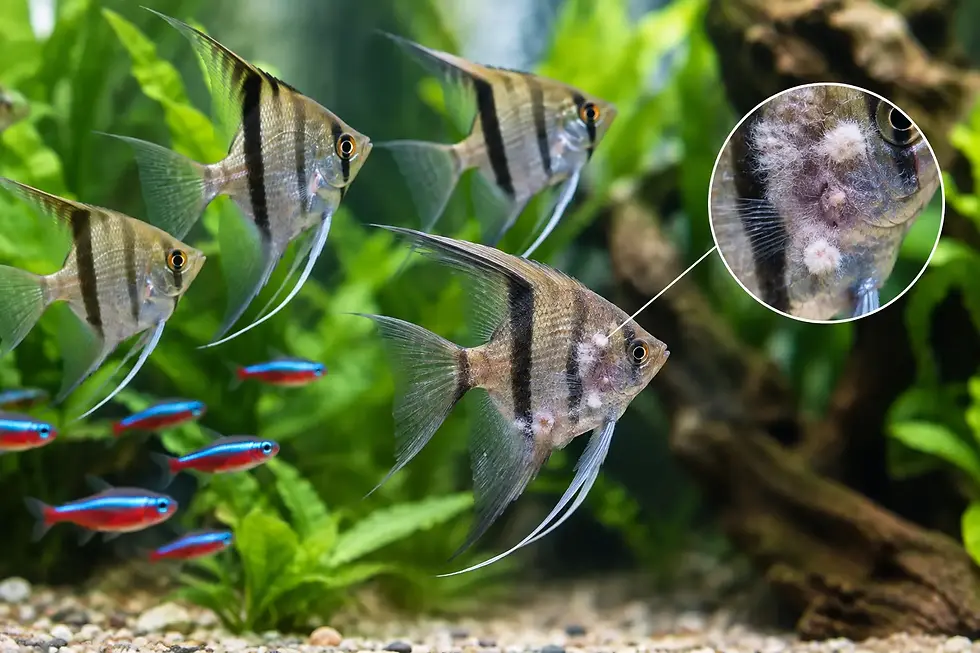
Visible signs need careful interpretation. White dots may suggest ich, but fine dusting can indicate velvet, while raised white nodules can have other causes. Frayed fins may be bacterial, but they may also be the result of fighting, sharp décor, or persistent poor water conditions. Clear photographs taken daily, ideally from the same angle and under similar lighting, are extremely useful for comparing progression.
Choose the Treatment for the Cause
Once the likely cause is identified, choose a medication formulated for that organism and suitable for the animals and system being treated. Read the full label before opening the product. Confirm the active ingredients, species restrictions, treatment duration, temperature requirements, and whether the medication can be used with plants, corals, shrimp, snails, or scaleless fish.
This is particularly critical in mixed systems. Copper-based treatments, for example, can be highly effective against certain marine parasites but are dangerous to invertebrates and should not be used in a reef aquarium. Some medications that are tolerated by many fish can harm shrimp, snails, or sensitive catfish and loaches. Pond treatments must also be selected with pond volume, water temperature, and the presence of filter bacteria in mind.
Avoid combining medications unless the manufacturer specifically permits it or there is a clear, informed reason to do so. Multiple products can create chemical incompatibilities, reduce oxygen, increase stress, or make it impossible to know which treatment helped or harmed. A treatment plan should be simple enough to evaluate.
When a Hospital Tank Is the Better Choice
A hospital tank is usually the best setting when only one or a few fish are sick, when the medication may affect invertebrates or the biological filter, or when targeted observation is needed. It does not need to be elaborate. A bare-bottom tank with stable temperature, aeration, a heater if appropriate, and a seasoned sponge filter is often sufficient.
For diseases that spread readily through the water, treating only the visibly ill fish may not be enough. Some parasites have stages that remain in the aquarium after the fish appears better. In those cases, the full system may require treatment. The decision depends on the disease life cycle, not simply on how many fish show signs.
How to Use Fish Medications at the Right Dose
Accurate volume is the foundation of correct dosing. Do not rely only on the aquarium’s advertised size. Substrate, rocks, wood, equipment, and a lower water line all reduce actual water volume. Measure tank length, width, and water depth, calculate the gross volume, then make a reasonable adjustment for displacement. For a pond, use its true dimensions and account for shelves, slopes, and irregular shape.
Use a graduated syringe, measuring cup, or scale appropriate to the product. Kitchen spoons are not precise enough for many treatments. Shake liquid medications if directed, and dissolve powdered products exactly as the instructions specify. Underdosing may fail to control the pathogen. Overdosing can injure fish, suppress appetite, damage gills, or affect the filter.
Follow the complete course, including repeat doses. Many medications are designed around the life cycle of a parasite or the time needed to suppress bacterial growth. Stopping because the fish looks better after two days can leave surviving organisms behind and allow the problem to return.
At the same time, do not extend treatment indefinitely without reassessing the diagnosis. If there is no improvement within the expected window, or if fish deteriorate, stop assuming that more of the same medication is the answer. Recheck water quality, review the symptoms, and consider whether the original diagnosis was incorrect.
Prepare the Aquarium for Treatment
Good preparation reduces treatment failures. Remove activated carbon, chemical resins, and other media that can absorb medication, unless the product instructions state otherwise. Turn off UV sterilizers and ozone during treatment when directed, since these can degrade some active ingredients.
Increase aeration. Many fish medications lower available oxygen directly or indirectly, particularly when they affect water chemistry or when sick fish already have compromised gills. Add an air stone, increase surface movement, and watch fish closely for gasping at the surface. In warm water, oxygen availability is lower, making aeration even more necessary.
Keep temperature stable. Raising temperature is sometimes recommended for specific parasites, but it is not a universal cure and can worsen oxygen stress. Do not increase temperature unless it is part of an appropriate treatment plan for the identified condition and is safe for every species in the system.
Reduce unnecessary stress. Keep lighting subdued, avoid netting fish repeatedly, and maintain a consistent feeding routine. Feed lightly if fish are eating, but remove uneaten food promptly. Good nutrition supports recovery; excess food degrades water quality at the moment the fish can least tolerate it.
Monitor the Fish, Not Just the Calendar
During treatment, inspect the fish at least once or twice daily. Watch respiration, balance, appetite, interaction with tankmates, and the appearance of lesions or parasites. Keep a brief log of dosing times, water-test results, behavior, and photographs. This creates a record that is far more useful than trying to remember whether a mark was larger yesterday.
Some signs of improvement occur quickly, such as reduced flashing or better appetite. Healing of damaged fins, ulcers, and skin may take longer, even after the underlying cause is controlled. A fish is not necessarily failing treatment because a wound remains visible for several days. Look for direction of change: less redness, cleaner wound margins, reduced swelling, normal breathing, and renewed feeding are more meaningful than instant cosmetic recovery.
Monitor the biological filter as well. Test ammonia and nitrite during and after treatment, especially when using medications known to affect nitrifying bacteria. If a water change is needed, calculate the dose replacement carefully. Many products require redosing only for the amount of water removed, while others follow a fixed schedule. The label instructions take priority.
Avoid the Most Common Treatment Errors
The first error is treating every problem as an infection. Correcting water quality, removing an aggressor, improving diet, or adjusting temperature may resolve the actual cause without medication. The second is using a broad product because it is already on hand. Convenience is not diagnosis.
Another frequent error is treating visible symptoms while overlooking the source. A fish may recover from a bacterial lesion, but repeated injuries from aggressive tankmates or unsuitable décor will create the next lesion. Parasite treatment can fail if new fish, plants, or equipment are introduced without appropriate quarantine. Medication addresses the disease process; management prevents its return.
Do not use expired products, guess at doses, or rely on medication colors and names as proof of their purpose. Active ingredients, concentration, and instructions matter. This is especially true when products with similar branding have different formulations for freshwater, marine, aquarium, or pond use.
A clear photograph, accurate water data, and a diagnosis-first reference are often more valuable than a cabinet full of medications. Gerald Bassleer Books is built around that practical sequence: recognize the disease pattern, distinguish it from look-alikes, and select treatment based on what the fish actually has.
When medication is justified, use it precisely and give the fish stable, clean, well-oxygenated water in which to recover. That disciplined approach protects more than the sick fish - it protects the entire system from the consequences of guesswork.


Opmerkingen