
Stappenplan visziekte diagnosticeren
A sick fish rarely gives you much time. One animal hangs under the surface, another starts flashing against decor, and by the next morning you may already have losses. That is exactly why a clear stappenplan visziekte diagnosticeren matters - not as theory, but as a practical method to move from visible signs to the most likely cause without guessing.
The biggest mistake in fish health management is treating first and diagnosing later. Many diseases look similar in the early stage. Rapid breathing can point to gill parasites, ammonia damage, bacterial infection, or low oxygen. White spots may be classic ich, but they can also be excess mucus, lymphocystis, or skin irritation. If you medicate too early with the wrong product, you lose time, stress the fish further, and often make the real problem harder to read.
Why a stappenplan visziekte diagnosticeren works
A reliable diagnosis starts with sequence. Experienced keepers do not look at one symptom in isolation. They assess environment, species affected, behavior, external lesions, and progression. That order matters because fish diseases are often triggered or complicated by water quality, stocking density, recent transport, aggression, or unstable temperature.
In practice, the goal is not to name every disease with absolute certainty on the first pass. The goal is to narrow the possibilities fast enough to choose the next correct action. Sometimes that action is treatment. Sometimes it is improving water quality, isolating affected fish, or observing for 12 more hours before intervening.
Step 1 - Start with the tank, not the fish
Before you inspect lesions, check the system. Measure ammonia, nitrite, nitrate, pH, temperature, and if relevant, salinity. Confirm aeration and water movement. Review what changed in the last week: new fish, new food, maintenance, filter cleaning, medication, transport, or a heater issue.
This step is often skipped because hobbyists want a visible diagnosis immediately. Yet many apparent disease outbreaks begin with environmental stress. Poor water quality can cause clamped fins, lethargy, gill irritation, excess mucus, and secondary bacterial problems. If several species are affected at once, especially after a recent system change, think environment first.
A useful rule is simple. If all fish look stressed, suspect the system. If one species is affected more than others, suspect species sensitivity or a host-specific pathogen. If one individual is sick while the rest remain normal, consider injury, social stress, or an early localized infection.
Step 2 - Read behavior before handling
Behavior gives early diagnostic information that lesions alone may miss. Watch the fish in the aquarium or pond for several minutes before netting anything. Note respiration rate, swimming pattern, posture, appetite, and social interactions.
Fish gasping at the surface may be dealing with low oxygen, gill disease, or toxin exposure. Flashing and rubbing suggest skin or gill irritation, often from parasites, but this can also happen with water chemistry problems. Isolated fish hiding in corners may be weak, septic, or heavily stressed. Loss of buoyancy control points you toward swim bladder issues, systemic disease, or severe intestinal problems, depending on the species.
Timing also matters. A fish that deteriorates within hours suggests acute poisoning, oxygen failure, or a fulminant infection. A fish that slowly loses weight over weeks suggests chronic parasitism, internal infection, poor nutrition, or social exclusion from food.
Step 3 - Examine the body surface in good light
Now inspect the fish closely. Good light is essential. Many diagnoses are missed because the keeper only notices that the fish is "off" without distinguishing whether the skin is producing excess mucus, whether the scales are raised, or whether lesions are sharply defined.
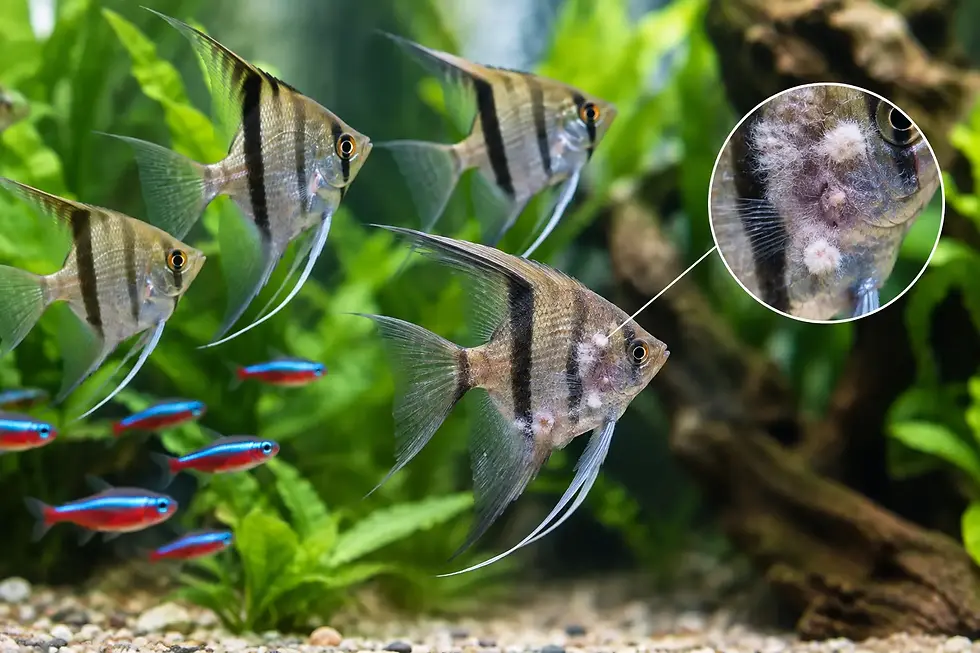
Start with distribution. Are the lesions on the fins, head, gills, flanks, or only near the mouth? Then assess type. Are you seeing white dots, cotton-like growth, ulcers, hemorrhage, frayed fins, a velvet-like dusting, nodules, or cloudy patches?
Pattern recognition is valuable, but it has limits. White dots of even size scattered over body and fins fit ich. A fine golden or gray film points more toward velvet. Cotton-like growth usually indicates fungal overgrowth on damaged tissue, but the primary cause may be trauma or bacterial disease. Fin erosion can be bacterial, yet poor water quality and aggression often start the process.
This is why visual diagnosis works best when paired with the earlier steps. A photograph in isolation helps, but a photograph plus behavior plus water data is far more powerful.
Step 4 - Check the gills and breathing
Gill problems are common and dangerous because fish can compensate for a while, then crash quickly. Rapid breathing, one-sided opercular movement, piping at the surface, and hanging near outflow all deserve immediate attention.
If you can safely examine the gills, look for color and texture. Healthy gills are usually a strong red to pink, depending on species. Pale gills may suggest anemia or severe stress. Brown gills can point to nitrite issues. Gills covered in excess mucus, swollen tissue, or visible debris often indicate irritation, parasites, or poor water conditions.
Do not assume every breathing problem is infectious. Warm water, overcrowding, organic buildup, and inadequate aeration can produce dramatic respiratory distress. On the other hand, if water parameters are acceptable and only selected fish are affected, gill flukes, protozoa, or bacterial gill disease move higher on the list.
Step 5 - Separate primary signs from secondary signs
This is one of the most useful parts of any stappenplan visziekte diagnosticeren. Fish often show secondary damage that distracts from the real cause. A fish with a skin ulcer may have started with parasite damage. A fish with fungus may first have suffered injury. A bloated fish may not have a "dropsy disease" as such, but kidney failure, septicemia, or severe osmotic imbalance.
Ask which sign appeared first. Did flashing come before the cloudy skin? Did appetite loss start before bloating? Did fin damage begin after aggression in the tank? When keepers reconstruct the timeline carefully, the diagnosis becomes much cleaner.
It also helps to ask whether the sign is local or systemic. A single mouth lesion may be trauma or a local bacterial infection. Pineconing, generalized edema, and bilateral exophthalmia suggest a whole-body problem. Systemic cases usually need faster, more intensive action and carry a more guarded prognosis.
Step 6 - Consider what fits the species and setup
Different fish do not get sick in the same way. Discus, koi, marine angelfish, livebearers, cichlids, and shrimp each have their own weak points and common disease patterns. The same visible sign can mean different things depending on species, age, and environment.
A marine fish with white dots raises a different level of concern than a pond fish with occasional skin spots. A shrimp colony with failed molts and lethargy pushes you toward mineral balance, toxins, and management factors as much as infection. A newly imported fish with weight loss and mucus should make you think about transport stress and parasites before rare diagnoses.
This is where specialized visual references are so valuable. Representative disease photographs, paired with concise case-based explanations, let you compare what you see with known presentations instead of relying on vague internet guesses.
Step 7 - Decide whether you need observation, isolation, or treatment
After the first diagnostic pass, you should be able to place the case into one of three categories. Some fish need immediate treatment because the signs are severe and the likely causes are narrow. Some need isolation for closer monitoring and to reduce spread. Others need environmental correction first, with treatment only if signs persist.
The trade-off is speed versus certainty. Waiting too long can cost fish. Treating too broadly can do the same. If there is heavy respiratory distress, obvious parasitic signs, or a fast-moving outbreak, action should not be delayed. If the fish is stable and the presentation is mixed, 12 to 24 hours of structured observation after correcting water issues can prevent a wrong medication choice.
When possible, document the case. Take clear photos in side view and close-up. Record test values, temperature, recent changes, and which fish are affected. This turns a stressful event into a diagnosable case instead of a blur of impressions.
Common diagnostic traps
Most failed diagnoses come from a small number of avoidable errors. The first is treating based on one symptom alone. The second is ignoring water quality because the fish has obvious lesions. The third is assuming that any white mark is ich or any swollen fish has dropsy.
Another trap is forgetting mixed disease. Fish under stress often have more than one problem at once. A parasite outbreak can be followed by bacterial infection. Chronic poor water quality can mask an infectious disease until losses begin. If a treatment partly works but the fish still decline, reassess rather than repeating the same medication.
For keepers who want a more exact method, Gerald Bassleer Books has built its reputation on this practical approach: identify the visible signs correctly, compare them to documented disease patterns, and connect diagnosis to treatment that fits the actual problem.
The best fishkeepers are not the ones who medicate fastest. They are the ones who observe carefully, compare signs accurately, and stay disciplined under pressure. When you follow a real diagnostic sequence, you give yourself the best chance to protect both the sick fish in front of you and the entire system behind it.
The next time a fish looks unwell, slow down just enough to diagnose with purpose. That pause is often where the right treatment begins.


Opmerkingen