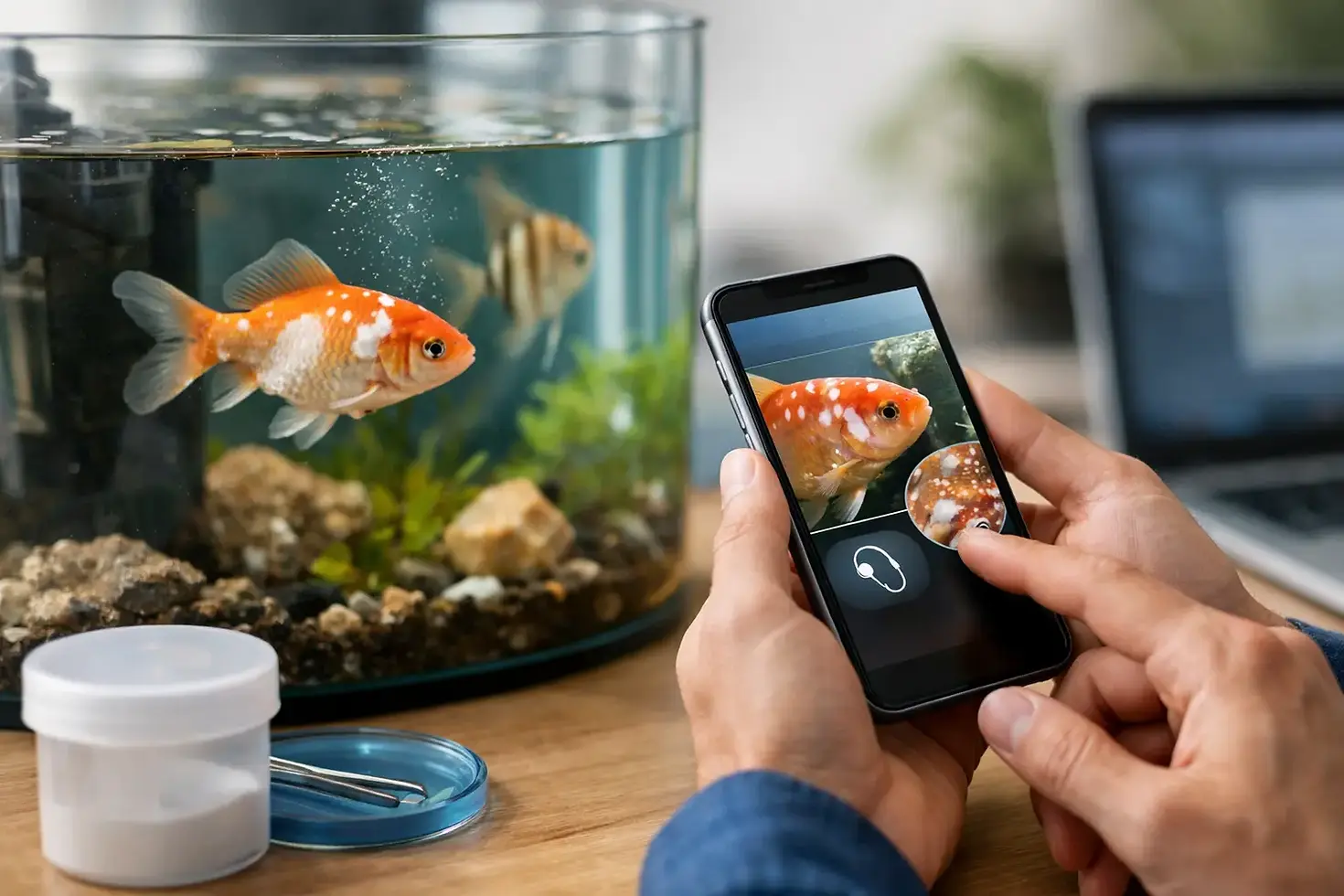
How a Fish Disease Diagnosis App Helps
A fish stops eating, isolates itself, and develops a pale patch near the gill cover. That is the moment when guesswork becomes expensive. In ornamental fish keeping, a delayed or incorrect diagnosis can cost livestock, destabilize a system, and lead to the wrong treatment. A fish disease diagnosis app is valuable because it shortens the distance between what you see and what you need to do next.
For serious keepers, speed matters, but speed without accuracy is risky. Many diseases look similar in the early stage. A fish flashing against objects may have parasites, poor water quality, gill irritation, or a combination of problems. White spots may be classic Ich, but they may also be something else entirely when the pattern, size, or fish behavior does not match. This is where a practical diagnostic tool earns its place.
What a fish disease diagnosis app should actually do
A useful app is not just a symptom list on a small screen. It should help you move from visible signs to a narrower and more defensible diagnosis. In practice, that means combining clear disease categories, strong photo comparison, concise descriptions, and direct treatment guidance.
The best tools begin with what the keeper can observe without specialized equipment. Is the problem on the skin, fins, eyes, gills, or mouth? Is the fish breathing heavily, clamping fins, darkening in color, producing excess mucus, or showing ulcers? A good app organizes these observations so that the user is not forced to search blindly through dozens of unrelated conditions.
Visual reference is essential. In fish health, wording alone often fails because hobbyists and even professionals may describe the same lesion differently. A raised white nodule, a matte skin film, and cotton-like growth are not interchangeable findings. Good diagnostic images reduce that confusion. When photographs show representative disease stages and common body locations, users can compare what they are seeing in real time.
Treatment guidance also needs to be practical. The app should not stop at naming a disease. It should help the user understand what action is appropriate, what level of urgency is involved, and where common mistakes happen. Sometimes the correct next step is medication. Sometimes it is isolation, water correction, microscopy, or simply stopping ineffective treatment before it causes more stress.
Why image-based diagnosis matters so much
Fish keepers usually begin with appearance and behavior because that is what they have. They do not start with lab data. They start with a fish that is scratching, fading, swelling, or developing lesions. A fish disease diagnosis app that relies heavily on image comparison reflects how diagnosis happens in the real world.
This is especially important in ornamental species because external signs can change quickly. Early bacterial lesions may resemble minor abrasions. Parasitic infections may present first as excess mucus before obvious skin damage appears. Fungal-looking growth may not be fungal at all. If an app provides high-quality images tied to short, experience-based explanations, it helps the keeper avoid the trap of treating the look rather than diagnosing the cause.
Video can add another layer. A still photo shows structure. A short video can show breathing pattern, buoyancy loss, erratic swimming, flashing, rolling, or lethargy in a way a written description cannot. For diseases affecting gills or neurological behavior, that difference matters.
The real problem is not lack of information
Most dedicated fish keepers already have access to plenty of information. The problem is sorting useful information from incomplete or misleading advice when time is limited. General fish forums and broad pet content often flatten disease diagnosis into simplistic labels. If a fish has white spots, it must be Ich. If a fish is bloated, it must be constipation. If a fish has a red patch, it must be bacterial. These shortcuts are common, and they are often wrong.
A specialist app is more useful because it is built around pattern recognition and differential diagnosis. It narrows the field. It shows where one condition overlaps with another and where the small differences matter. That is a more realistic approach for aquarium, pond, marine, and shrimp keepers who deal with species-specific sensitivity and different disease pressure across systems.
Where a fish disease diagnosis app is most helpful
The app is most effective in the first stage of investigation, when the keeper needs orientation quickly. It is also valuable when symptoms are visible but not yet severe, because early intervention often improves outcomes.
In freshwater aquariums, it helps with common but easily confused problems such as external parasites, bacterial skin disease, fin erosion, wasting conditions, and gill disorders. In ponds, where observation is often less controlled and fish may be viewed at a distance, visual references help focus attention on the most probable conditions before the problem spreads. In marine systems, where many species mask illness until late stages, rapid visual guidance can help the keeper distinguish stress signs from infectious disease. Shrimp keepers benefit as well, especially because shrimp losses are often fast and symptom interpretation is notoriously difficult.
That said, an app is not a microscope, culture test, or necropsy. It should be treated as a practical diagnostic aid, not as a replacement for every other method. In difficult cases, mixed infections or environmental damage can produce overlapping signs. The app helps you make a better first decision, not a perfect decision in every case.
What separates a specialist tool from a generic app
A generic pet health app usually aims for breadth. A specialist fish disease diagnosis app should aim for depth. That difference is critical.
Specialist tools are built around real disease presentation in ornamental aquatic animals. They account for the fact that the same disease may appear differently across species, body areas, and severity stages. They also recognize that treatment decisions in fishkeeping depend on context. A medication suitable for one setup may be inappropriate in another because of invertebrates, filtration sensitivity, salinity, or the condition of the fish.
This is also where educational quality matters. Strong specialist content does not overpromise. It explains when a diagnosis is likely, when it is uncertain, and what observations would increase confidence. It teaches users how to look, not just what to buy.
Gerald Bassleer Books has built its reputation on exactly this kind of practical disease recognition, where visual comparison, concise explanation, and treatment direction work together rather than separately.
How to use the app without falling into common traps
The first trap is searching for one dramatic symptom and ignoring the rest. A single white mark does not tell the whole story. Breathing rate, appetite, posture, body condition, social behavior, and spread within the population all matter. The app is most useful when the keeper collects a full picture first.
The second trap is treating too early with the wrong product. If you medicate before narrowing the diagnosis, you may mask symptoms or stress the fish further. A good app helps prevent this by showing likely alternatives and encouraging visual confirmation.
The third trap is separating disease from environment. Water quality problems often act as the primary cause, a secondary trigger, or a major complicating factor. A fish with inflamed gills may have parasites, but poor oxygenation or ammonia exposure may also be involved. Diagnosis should always be linked to system conditions.
For best results, examine the fish under strong light, compare multiple images, and look for consistency across several signs rather than one. If possible, review progression over 24 to 48 hours unless the case is clearly urgent. That short window often reveals whether a lesion is spreading, whether more fish are affected, and whether the pattern matches the suspected disease.
The value of having diagnosis in your pocket
Reference books remain indispensable for serious study, but an app changes the speed of use. When you are standing in front of a quarantine tank or checking a pond at dusk, convenience matters. A mobile format lets you compare lesions immediately, review likely causes, and decide whether to isolate, observe, or treat.
That convenience is not trivial. In fish health, delays often come from friction. The right information exists, but it is not close at hand when needed. A well-designed app removes that barrier. It brings practical diagnosis into the moment where observation happens.
For dedicated keepers and professionals alike, the goal is not to replace judgment. The goal is to support better judgment with visual evidence, structured reasoning, and treatment guidance that reflects real fish health work. A reliable fish disease diagnosis app does exactly that. It helps you stop guessing, start observing with purpose, and give the animal a better chance while there is still time.


Opmerkingen