Vijvervis ziekte herkennen: zo kijk je goed
- gerald294
- 23 jun
- 6 minuten om te lezen
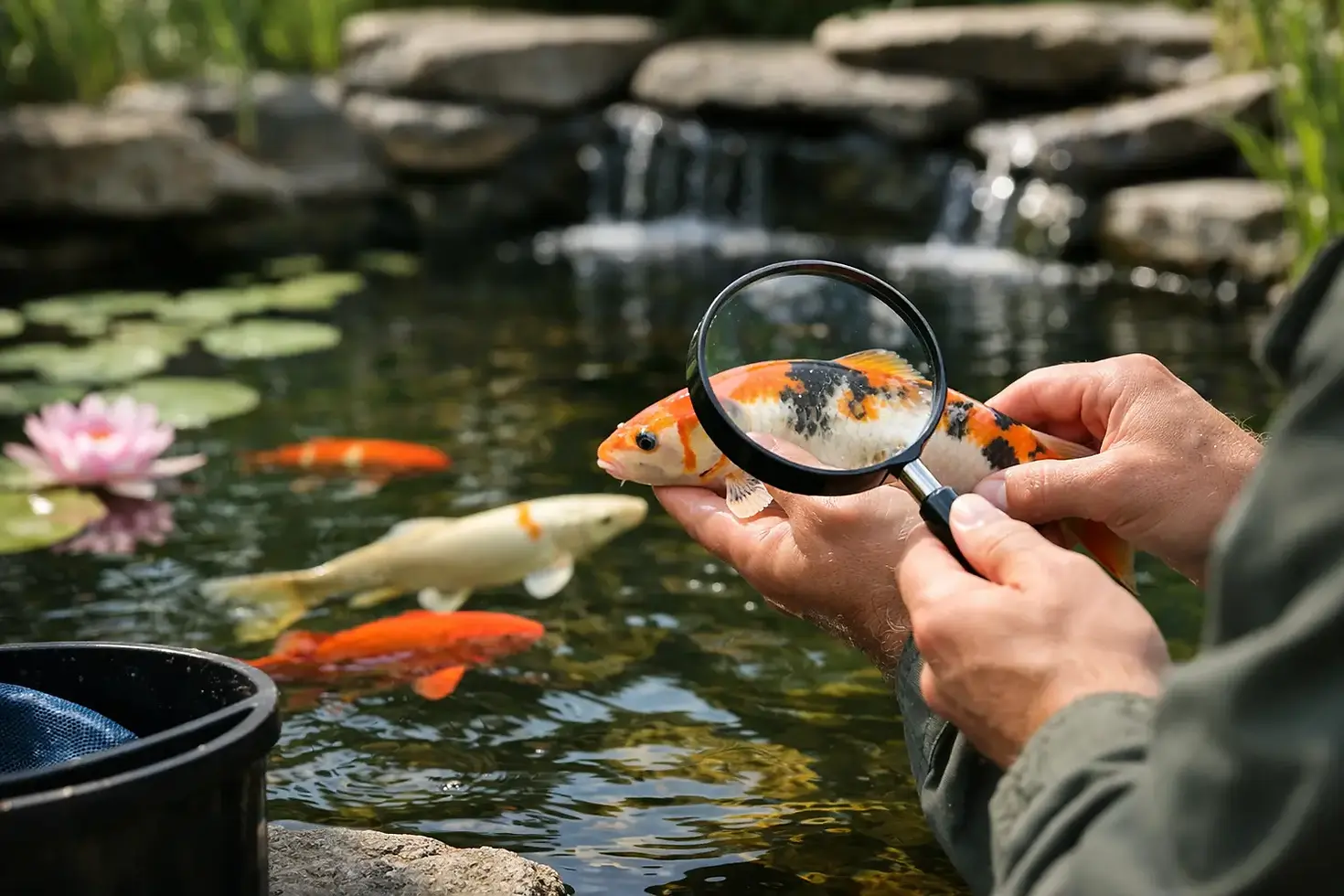
A koi that suddenly isolates itself, stops feeding, or clamps its fins is already telling you something. Vijvervis ziekte herkennen starts there - not with medication, but with disciplined observation. In pond fish, the visible symptom is rarely the full diagnosis. Reddened skin can point to trauma, parasites, bacterial infection, or poor water quality. The keeper who treats too fast often treats the wrong problem.
For serious pond keepers, this is the critical distinction: a symptom is a clue, not a conclusion. If you want better outcomes, you have to work from what you see on the fish, how the fish behaves, and what the environment is doing at the same time.
Vijvervis ziekte herkennen begint met patroon, niet met paniek
Most diagnostic mistakes happen in the first hour. A fish flashes against the wall, and the immediate assumption is parasites. A fish has a pale patch, and the assumption becomes fungus. Sometimes that is correct. Often it is not.
A more reliable approach is to look for patterns. Is one fish affected, or many? Did the problem appear suddenly after a water change, transport, or temperature swing? Are the lesions symmetrical or random? Is the issue mainly on the skin, the fins, the gills, or in behavior? Those details narrow the field quickly.
A single fish with a torn fin and localized redness may be dealing with injury and secondary infection. Multiple fish gasping at the surface suggest an environmental problem first, especially oxygen shortage, ammonia stress, or gill damage. Fish rubbing against objects with excess mucus often raise suspicion of ectoparasites, but flashing can also follow irritation from poor water conditions.
Good diagnosis is comparative. You are not just asking, What looks wrong? You are asking, What combination of signs appears together?
Start with behavior before you inspect the body
Behavior often changes before the body shows obvious damage. That is why the first diagnostic tool is not a treatment bottle - it is time spent watching the pond calmly.
A healthy pond fish holds itself in the water with control, reacts predictably, and eats with interest. A sick fish may become reclusive, hover near returns, stay at the surface, rest on the bottom, swim erratically, or lose interest in food. None of these signs identify a disease by themselves, but they tell you where to look next.
Gasping is especially important. When fish gather near waterfalls or inflows, think first about oxygen and gill function. Heavy breathing can reflect low dissolved oxygen, gill parasites, toxic water conditions, or severe systemic illness. Treating for skin parasites when the real problem is the gill is a common and costly error.
Loss of appetite also needs context. In cold water, reduced feeding may be normal. In stable warm conditions, a fish that stops eating deserves attention. If feeding stops across the pond, test the environment first. If only one fish stops eating, inspect that individual more closely for mouth lesions, buoyancy issues, or early disease.
What to look for on the skin, fins, eyes, and gills
Once behavior tells you there is a problem, move to the visible body surfaces. This is where many keepers see disease, but the challenge is interpreting what they see correctly.
Excess mucus is one of the most useful signs. Fish may appear dull, grayish, or coated. That usually means irritation. The cause may be parasites, water quality stress, or chemical damage. A slimy fish is not automatically infected with one specific organism.
Redness is another broad sign. Fine red streaks in fins, inflamed areas at the base of fins, or bloodshot patches on the skin can reflect septicemia, ulcerative disease, trauma, or poor water conditions. The location matters. Diffuse redness over several fish often points back to the pond environment. A sharply defined inflamed wound on one fish may suggest injury with secondary bacterial involvement.
White patches also require caution. Cotton-like growths can be true fungal overgrowth, but flat pale areas may be mucus change, healing tissue, or parasitic irritation. A white appearance is a visual category, not a diagnosis.
Raised scales, abdominal swelling, and protruding eyes suggest internal involvement and should be taken seriously. These signs often indicate advanced disease rather than an early, simple skin problem. Prognosis depends on the cause and how long the fish has been affected.
Gill changes are among the most important findings, yet they are often missed because keepers focus on the skin. Pale gills can indicate anemia or severe stress. Brownish gills raise concern for toxic exposure. Very swollen or damaged gill tissue points toward parasites, infection, or water quality injury. If respiration is abnormal, gills deserve direct attention.
Vijvervis ziekte herkennen vraagt ook om waterdiagnose
A pond fish lives in its diagnostic background. That background is the water. Any attempt at vijvervis ziekte herkennen that ignores ammonia, nitrite, pH, temperature, oxygen, and recent management changes is incomplete.
Poor water quality can mimic infectious disease very convincingly. Fish may clamp fins, flash, develop excess mucus, show red areas, breathe heavily, and stop eating. Those signs can send keepers toward medication, while the actual problem is environmental stress. In that situation, treatment may worsen the case.
This is why timing matters. Ask what changed in the last few days. New fish, filter cleaning, overfeeding, algal bloom crash, medication use, heavy rain, heat, and transportation can all shift pond stability. Disease often appears after stress lowers resistance. The trigger and the pathogen may both be part of the picture.
The practical rule is simple: when multiple fish show similar distress, assume the pond itself may be involved until testing proves otherwise.
Common signs and what they may mean
Certain symptom groups appear repeatedly in pond practice. Flashing with excess mucus often suggests skin irritation, especially external parasites, but poor water can produce the same picture. Ulcers and red wounds raise suspicion of bacterial disease, though many begin with parasite damage or trauma. Clamped fins and lethargy are general illness signs and do not point to one specific cause.
Fish that become dark in color, isolate, and stop feeding are often under significant stress. Fish that lose buoyancy control may be dealing with systemic disease, intestinal problems, swim bladder issues, or severe weakness. Small white spots can suggest a parasitic disease, but spot size, distribution, and speed of onset matter.
This is where visual reference is indispensable. Serious keepers benefit from comparing what they see against reliable disease photographs and verified case examples. Guessing from memory is risky because many diseases overlap in appearance during the early stages.
When visual diagnosis is enough - and when it is not
Visual inspection can take you far, especially when signs are characteristic and the pond history is clear. But there are limits. Parasites that produce similar irritation may look identical from a distance. Bacterial lesions can resemble one another. Gill disease, in particular, is often underestimated without closer examination.
If fish continue to decline, if mortality starts, or if treatment has already failed, deeper diagnosis becomes necessary. That may mean microscopic examination of skin mucus or gill tissue, closer handling of the fish, or consultation with an aquatic health specialist. Experienced fish keepers know that microscopy is not an optional luxury when the case is unclear - it is often the step that prevents repeated failure.
This is also the point where many hobbyists lose time by treating in sequence: one product for parasites, then one for fungus, then one for bacteria. Besides stressing the fish, this approach obscures the original signs. A correct diagnosis made early is usually safer than a series of broad guesses.
A practical sequence for pond keepers
When a fish looks abnormal, first observe from a distance and record the behavior. Then inspect whether the problem affects one fish or several. Next, assess the body surface carefully - skin, fins, eyes, gills, mucus, wounds, swelling. Test the water before you medicate. Then ask what changed recently in management, stocking, weather, or filtration.
If the signs remain unclear, isolate only when necessary and only if the isolation setup is stable and well aerated. Poor quarantine conditions can create a second problem. If lesions worsen, respiration is abnormal, or fish die, move toward microscopic confirmation rather than broader guesswork.
This method is less dramatic than immediate treatment, but it is far more effective. It mirrors how strong fish medicine works in practice: observe, compare, confirm, then treat.
For keepers who want faster and more accurate answers, specialist visual references are essential. Gerald Bassleer Books has built its reputation on exactly that need - helping fish keepers connect visible signs with the most likely disease process and appropriate response.
The best pond keepers are not the ones who medicate fastest. They are the ones who notice small changes early, read symptoms in context, and respect the difference between a sign and a diagnosis. That is how fish are saved before a manageable problem becomes a major loss.


Opmerkingen